
Flower growers are moving more direct trading connections to Floriday as the platform prepares a separate change that will make unanswered order correction and cancellation requests automatically take effect. The developments give participating growers and buyers two immediate tasks: confirm how their trading connections will move and establish who will review requests before the response period ends.
Floriday announced Sept. 23 that a group of growers had begun moving buyers’ existing virtual marketplace connections, known as VMP connections, to its platform. It said the first group of buyers was expected to complete the transition by Dec. 1. Separately, an Aug. 31 notice said the new handling of unanswered correction and cancellation requests would begin Oct. 1.
Direct trading connections move to a shared platform
The participating growers are Arcadia, Borst Bloembollen, Holstein Flowers, Moerman Lilium, Jac. Oudijk, Vicini Nursery, Together2Grow, Unicum Freesia and Zentoo, according to Floriday. The company says growers will inform buyers as the transition progresses and that both sides will receive support.
The announced transition concerns the connections used for direct electronic trading. It does not establish that every buyer has already moved or that Dec. 1 is a deadline for every business using the platform. Floriday describes that date as the target for the first group.
In its June explanation of the approach, Floriday said centralizing VMP connections would give users one place to manage settings and view the supply they receive while preserving the direct relationship with a trading partner. Those are the platform’s stated objectives; the notices do not provide independently measured savings or an error-reduction rate.
For a buyer coordinating several suppliers, the practical issue is the handoff between an existing connection and its replacement. A sensible preparation checklist is to identify each affected grower, confirm the agreed transition date and assign a staff member to compare the availability and order information before and after the move. These are operational considerations, not additional requirements announced by Floriday.
Unanswered requests will have a different outcome
Floriday’s Oct. 1 change gives counterparties two working days to approve or reject a correction or cancellation request, replacing the previous one-working-day response period. If no response is received, the request will be approved automatically, the company says.
The announcement says requests will remain available through dashboard tasks and the Corrections section. It recommends enabling notifications and says a reason must be supplied when a request is rejected. The company also describes trade settings that allow growers and buyers to configure automatic approval, including grower settings based on a chosen amount.
The longer response period should not be confused with permission to leave requests unattended. For the businesses involved, the important change is what happens when nobody responds. A missed request can now result in approval under the announced procedure rather than simply expiring.
Teams can prepare by assigning responsibility for the request queue and naming a backup for absences. Buying, sales and administrative staff should know which person can accept a proposed change and when an exception needs review. Companies should also check that notifications reach the people who actually handle orders, rather than assuming an account administrator will see every message in time.
Check the order details and current guidance
Floriday’s grower help documentation explains that corrections can involve price per piece, package quantities, pieces per package and packaging codes. Some delivery changes depend on whether an order has already been processed. That makes a request more than a general message: the fields being changed need to be understood before a decision is made.
Documentation retrieved for this report included an older help-page version describing expiring requests, alongside the newer announcement of the Oct. 1 procedure. Businesses should use the current guidance linked from Floriday’s announcement for implementation details and confirm any uncertainty with platform support. This report does not calculate individual response deadlines or assume how holidays affect them.
These direct-trading developments follow SuperFloral’s earlier coverage of auction-clock migration. That story concerned changes to auction technology. Buyers should keep the separate processes clear when briefing staff or discussing changes with suppliers.
For mass-market floral sourcing teams, the takeaway is practical: identify the suppliers and connections affected, verify that order information remains usable during the transition and make responsibility for corrections explicit. Centralized technology may simplify administration, but it does not remove the need for a person to review a disputed quantity, price or cancellation.
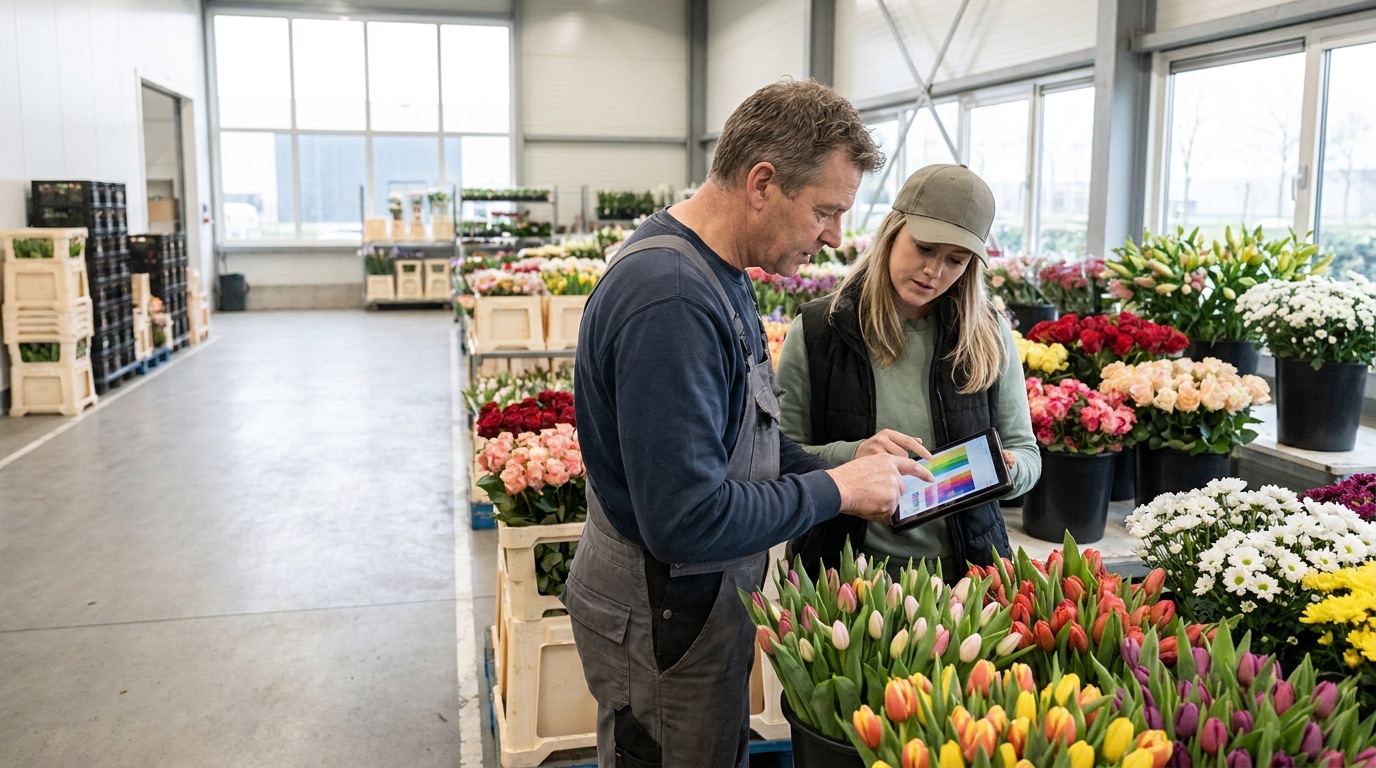
Sources: Floriday’s Sept. 23 migration announcement; Oct. 1 procedure announcement; VMP background; grower correction guidance. Operational recommendations are editorial analysis. Illustration: AI-generated illustration created for SuperFloral; it does not depict Floriday’s interface or an actual facility.

Travis Rigby is the publisher of SuperFloral, the news source for the mass-market floral industry. He leads its website and weekly newsletter, covering what matters to growers, breeders, supermarket floral buyers and category managers. Travis studied journalism at the University of Utah, founded and led PosterGarden.com for 27 years, and is president of FlowerBox.com.