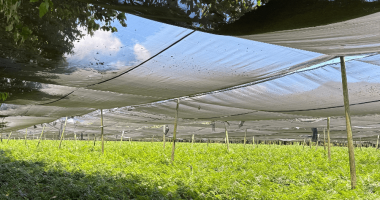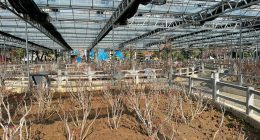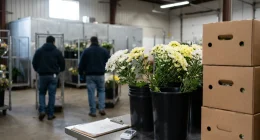

The greenhouses of El Organal, in San Juan del Río, operate with central ventilation windows, drip irrigation, and cold rooms to optimize water use. According to Ismael Martínez, the growth of floriculture in the community depends on water availability. “We are somewhat limited, in terms of resources, such as water.”
The sector expects to grow from 150 to 200 rose growers over the coming production cycles, contingent on bringing in new water sources without over exploiting existing ones. Currently, growers combine water from the Constitución reservoir, deep wells, and synthetic-membrane cisterns that capture rainwater from greenhouse rooftops, which is then pumped back into the irrigation system.

The Constitución reservoir, located in La Estancia, supplies growers year-round, while deep wells serve as backup. Rainwater harvesting is advancing through the growers’ own initiative, with cisterns excavated alongside the production structures. Based on available information, this investment is recent and does not yet have the backing of a systematic state support program.
On the technical side, the greenhouses incorporate cross-ventilation through central windows, point-to-point drip irrigation, dosed fertigation, cold rooms, and humidity-controlled chambers. This infrastructure is used for crop management and post-harvest storage.
The semi-arid Bajío region faces ongoing pressure on its aquifers. The National Water Commission has maintained a partial drilling ban on several wells in the San Juan del Río valley for more than a decade. The floriculture activity in El Organal shares water resources with maize, wheat, and barley crops, as well as the domestic supply for around 6,000 residents.
Greenhouse tours conducted with students from the Autonomous University of Chapingo showcase the rainwater harvesting system and its management. This aspect will also be featured at the Festival de las Rosas on May 24, which aims to highlight both the flower offering and the production conditions.
Ismael noted that the community’s next step is to bring in specialized packing facilities that meet export standards, as part of a phase being explored with the United States market in mind. Modernization is being financed with the growers’ own resources; they point out that no specific state credit line yet exists to help expand rainwater harvesting capacity among those who do not yet have cisterns.
Read more at rotativo.com.mx.

The SuperFloral Team brings you news, trends and practical ideas for supermarket and mass-market floral professionals. Our editors gather and curate the stories that matter most to floral teams in grocery and retail, from industry news and events to merchandising inspiration and business advice. Have a story idea or news tip? Write to us at editorial@superfloral.com.