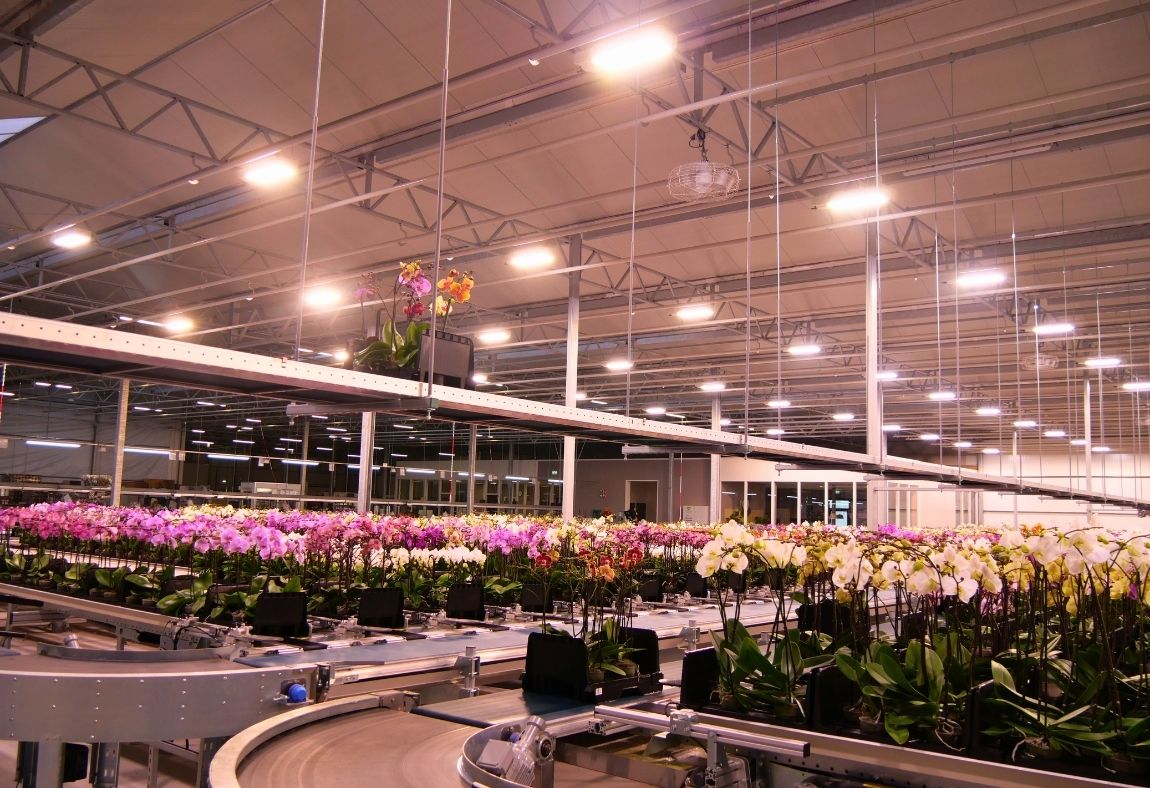

Dutch orchid grower Opti-flor has put a fully automated plant-order system into operation at its new Waellandweg facility, linking plant classification, buffering and order fulfillment in a single production flow.
Developed with WPS Horti Systems, the installation is designed to reduce manual searching and sorting while protecting plant quality through staking, flowering, buffering and packing. The supplier says the project followed more than two years of planning, weekly construction meetings, engineering and installation.
The system provides a useful case study for ornamental growers weighing automation against persistent labor pressure, increasing assortment complexity and the need to fulfill retail orders accurately during peak periods.
Vision data follows each plant
After staking, an Aris vision system evaluates plants for maturity, height and number of branches. The classification data is linked to an RFID tag in the plant carrier, enabling the system to sort and route plants automatically.
Opti-flor and WPS also developed a stable six-cell tray with spacing intended to reduce plant damage as orchids move on conveyors. RFID identification allows the system to track which plant classification is carried in each tray.
That combination of machine vision, order data and physical tracking addresses a central challenge in potted-plant production: maintaining the identity and quality grade of a living product as it moves through several handling stages.
A buffer designed for 30,000 plants
Following the flowering phase, trays are recognized automatically and directed to the appropriate buffer lane. WPS says the installation contains 263 buffer lanes with total capacity for 30,000 plants.
When an order enters the system, trays move from the buffer to the designated packing stations. Workers no longer need to locate and sort plants manually for each order, potentially reducing travel, repetitive handling and fulfillment errors.
An independent route returns empty trays from packing to the tray stacker and then to the infeed station. Closing that loop supports continuous operation and reduces the need to reposition trays by hand.
Automation must support quality, not only speed
For ornamental growers, faster movement is useful only when product quality is maintained. Orchids can be damaged by poor spacing, unnecessary contact or excessive handling. The dedicated tray design and classification controls show how automation must be adapted to the crop rather than applied as a generic conveyor solution.
Peak capacity is another important consideration. A system may perform efficiently during normal weeks but still become a bottleneck when holiday or promotional orders concentrate demand. WPS says intake, output, staking stations, buffers and packing stations were balanced around Opti-flor’s required peak capacity.
Questions for growers considering automation
Businesses evaluating similar investments should examine labor savings, throughput and accuracy alongside maintenance, integration, training, redundancy and the cost of downtime. They should also consider whether current crop grading and order data are consistent enough to support automated decision-making.
The Opti-flor project illustrates a larger shift in commercial floriculture: automation is moving beyond isolated equipment toward connected systems that coordinate plant data, internal logistics and customer orders.
The performance information is supplied by WPS Horti Systems and has not been independently audited. Even so, the project offers concrete design details that other growers can use when developing their own automation requirements.
Source: WPS Horti Systems

Travis Rigby is the publisher of SuperFloral, the news source for the mass-market floral industry. He leads its website and weekly newsletter, covering what matters to growers, breeders, supermarket floral buyers and category managers. Travis studied journalism at the University of Utah, founded and led PosterGarden.com for 27 years, and is president of FlowerBox.com.