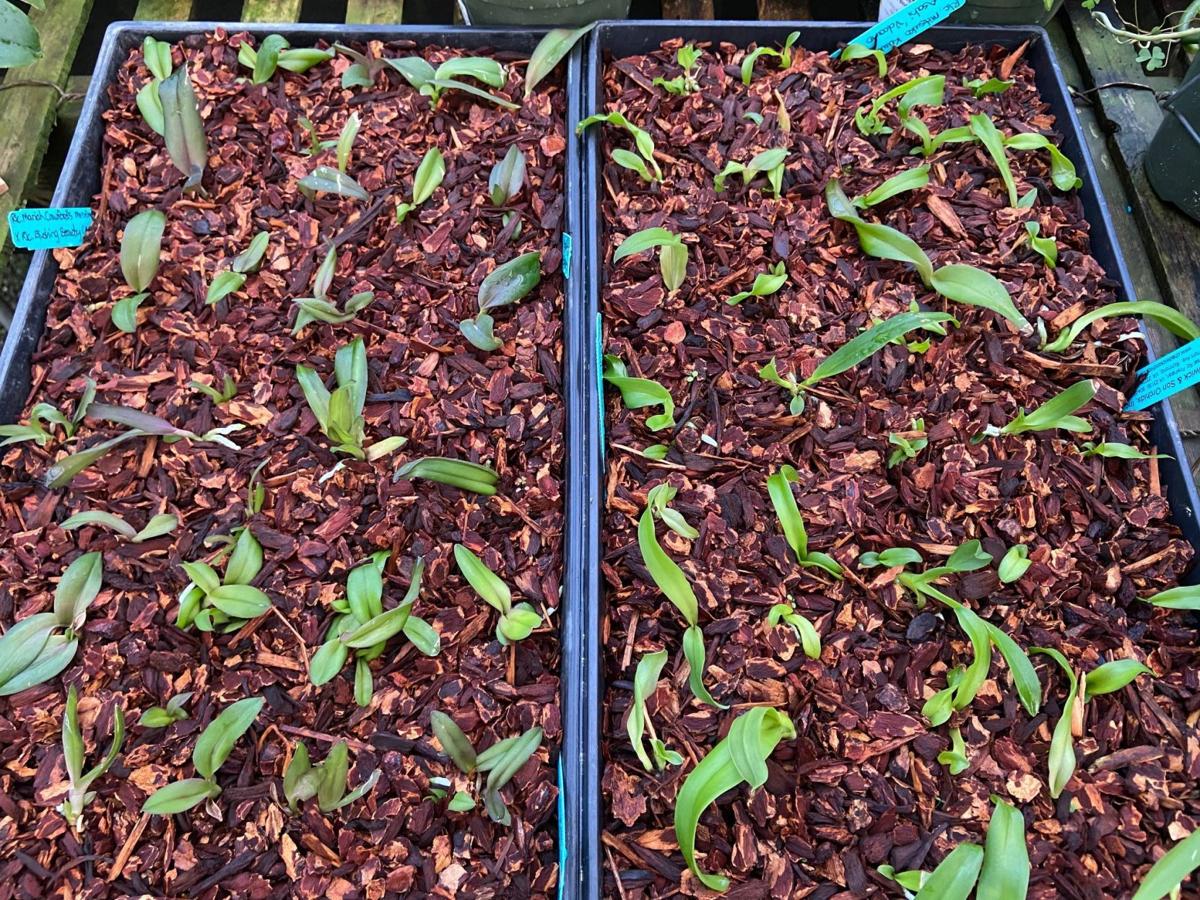

These seedlings were recently taken out of flasks and planted in trays with small bark chips. Both amateurs and professionals enjoy the thrill of raising hybrids since the outcome is a surprise. There are two schools of thought when it comes to raising young orchids to maturity. The prevailing opinion is to grow genetically identical plants or “clones” that have been pre-selected for superior vigor and flower quality. But there are dissenters who instead choose to propagate hybrids that are inherently full of surprises — some good, some bad, and mostly about average. In the early days of orchid breeding, which encompassed the latter half of the 19th century, there was much excitement about cross-pollinating two different species. The results were anyone’s guess, and lavish parties were thrown when a flower first opened. Traits of each parent were identified, and the next logical step was to make another hybrid. Unfortunately, mortality rates of these plantlets were very high. Little was known about the process of raising tiny orchid seeds that were impossibly slow-growing and prone to rot. More often than not, only a scant few made it to maturity, but the time commitment for the grower was seven years or more. In 1922, a botany professor at Cornell University, Lewis Knudsen, published a scientific method for propagating orchid seeds in sterilized glass beakers or flasks. This process revolutionized the orchid industry, and, for the next 40 years, breeding was practiced at a breakneck pace with untold numbers of newly created hybrids. We can trace the great cattleyas in history to this time period — C Bow Bells (big white 1945), Blc Norman’s Bay (big purple 1946), and Slc Jewel Box (compact red 1962), to name a few. Ultimately, a method for orchid cloning was invented that allowed for mass production of identical plants, and today nearly all nurseries use this. Hobbyists can participate in the excitement of raising seedlings and obtain flasks from established breeders around the country. Typically, there are 20 plantlets in a bottle, and the price starts at $50, depending on the parentage and the source. […]

The SuperFloral Team brings you news, trends and practical ideas for supermarket and mass-market floral professionals. Our editors gather and curate the stories that matter most to floral teams in grocery and retail, from industry news and events to merchandising inspiration and business advice. Have a story idea or news tip? Write to us at editorial@superfloral.com.