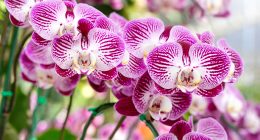
Everything’s big: An orchid egg sack What is it about orchids that turns sane people into obsessed collectors and fanatics? Especially the legendary black orchid? If you look, black orchids are everywhere and nowhere. Movies such as Black Orchids — a 1917 silent film; the classic comic-strip, Brenda Starr, Reporter , whose main squeeze depended on a concoction of black orchids to survive; iconic explorer Colonel Percy Fawcett who disappeared in the Amazon rainforest in 1925, looking for, legend says, the elusive black orchid. Except no-one had ever seen one, until Fred Clarke turned up. This orchid breeder has created the world’s first actual black orchid. Black orchids, 4-5 years old. “Bird” in middle is reproduction stem Up here in the hills surrounding Vista, in a humid hothouse, Clarke’s colleague Carlos Lopez leads me through rainbow racks of orchids. The black orchid was a holy grail for orchid hybridizers, he says. He leans over and from behind some other multi-colored orchids, pulls out a black orchid plant! The flowers are deep purple black, each with a bird-shaped sexual organ column sticking up in the middle, and a velvety sensuality about them. Fred Clarke says he managed, through years of cross-pollination, hand-“impregnating” different colored flowers’ reproductive organs with other orchids’ tiny micro-seeds, to create the first-ever really black, black orchids. Clarke’s breakthrough happened 13 years ago. But that was after waiting five, six years for his hybrids to slowly grow up, to see if they would actually produce when they came to maturity. They did. “Fred was the first person on the planet to lay eyes on a black orchid,” says Lopez. “He has called it the ‘FredClarkeara After Dark.’” Young orchids. No soil: roots in bark Normally, orchids don’t need help reproducing. They play sex games like the rest of us. They grow leaf extensions that actually look like bees. “Every orchid species has about one or two precise pollinators to attract the correct insects,” he says. To get pollinated, orchids play insects for fools. “Sometimes, their fragrance mimics pheromones given off by certain female insects, to trick males […]
Source: www.sandiegoreader.com

The SuperFloral Team brings you news, trends and practical ideas for supermarket and mass-market floral professionals. Our editors gather and curate the stories that matter most to floral teams in grocery and retail, from industry news and events to merchandising inspiration and business advice. Have a story idea or news tip? Write to us at editorial@superfloral.com.