
Week ending Oct. 24, 2026
Winter flowers are beginning to enter the Dutch marketplace while autumn products still fill auction clocks, and a new U.S. consumer survey puts affordability at the center of holiday shopping. For mass-market floral buyers, the combination calls for a measured seasonal transition: secure the products and transport a program needs, then replenish against actual store sales.
This floral market wrap up connects fresh marketplace observations, auction technology and retail research with the decisions facing grocery, supermarket and club floral teams. Freight data add another caution: a steady global rate can conceal a sharp move from an individual origin. The recommendations below are editorial analysis, not measured outcomes from the sources.
Autumn and winter supply overlap
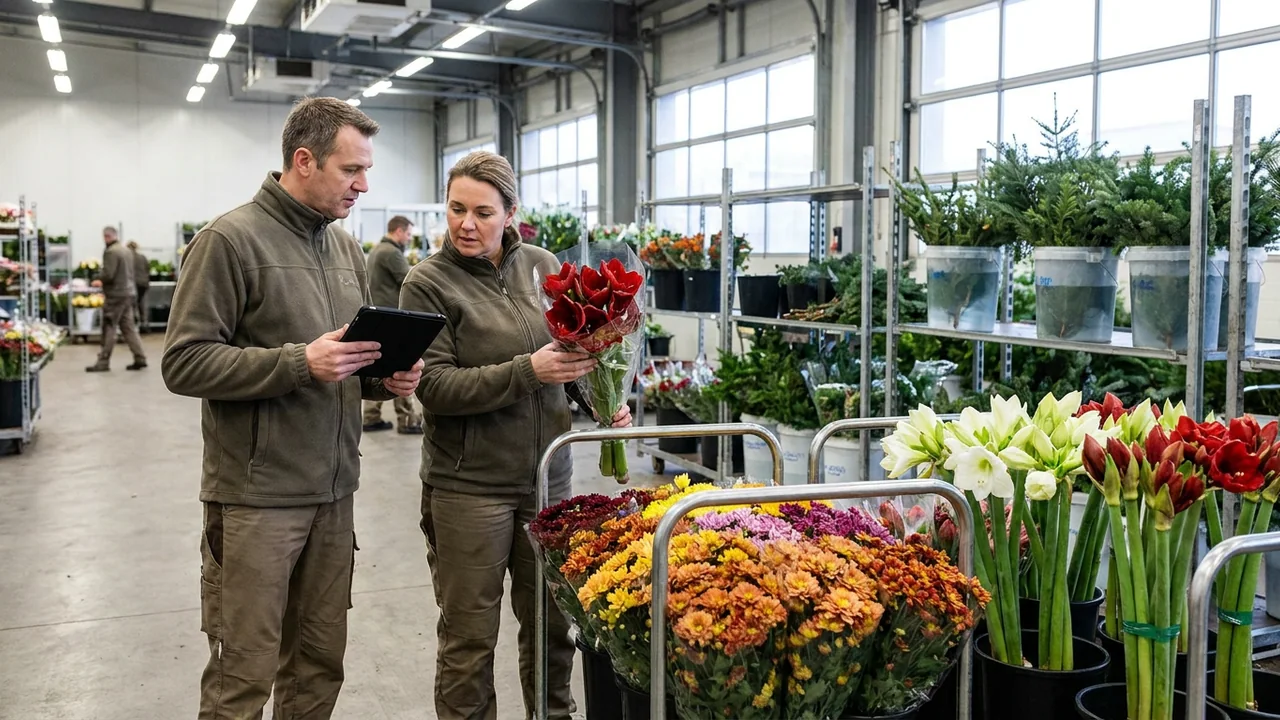
In her Oct. 23 column, Royal FloraHolland auctioneer Luus Hooyman described chrysanthemums, heather, calluna and pumpkins on the auction block, alongside the first amaryllis, Christmas greenery and other winter products.
“Whilst one season is still in full swing, the next is already on the horizon,” Hooyman wrote.
Her account is a firsthand observation of that marketplace, not a quantified supply forecast or evidence that every origin has ample inventory. It does, however, identify a useful purchasing checkpoint: distinguish a product’s first appearance from dependable volume for a chainwide promotion.
Ask growers and bouquet makers for shipment-week commitments, usable grades and approved substitutions before broadening a winter assortment. Keep autumn replenishment tied to remaining selling days. A mixed seasonal display can serve different shoppers, but an early winter arrival should not automatically trigger an early volume build.
Auction migration reaches a new stage
Hooyman’s column also reported that all auction clocks had successfully migrated to RFH Auction on Floriday behind the scenes. That is a material update to earlier reports describing a gradual transition. It concerns the auction environment; it should not be confused with the separate migration of direct trading connections or assume that every customer’s workflow has changed in the same way.
For buyers and intermediaries using the marketplace, the next operational check is straightforward: confirm purchasing access, staff familiarity, order reconciliation and the handoff to collection. A completed technical migration does not establish faster deliveries or lower costs. Review actual exceptions before changing staffing or service promises.
Keep this development separate from the digital offer features described in last week’s wrap up on flower prices and freight costs. Those features concern how offers and expected stock can be structured; this week’s report concerns the auction system itself.
Holiday shoppers are watching value
The National Retail Federation’s Oct. 20 holiday survey release said 56% of holiday shoppers expect the economy to affect their spending plans. Among that group, 43% plan to shop sales more often. Grocery stores were among the intended shopping destinations for 43% of holiday consumers.
The NRF survey, conducted by Prosper Insights & Analytics, asked 8,094 adults about shopping plans Oct. 1-7 and reported a margin of error of plus or minus 1.1 percentage points. These are stated intentions across holiday shopping, not observed floral transactions.
Timing also matters. The survey found 43% of holiday shoppers planned to start browsing and buying before November, while 64% said they were likely to wait until Thanksgiving weekend to do most of their shopping. Early activity and later purchasing can coexist.
For floral teams, the implication is to make value visible without assuming more stems will sell. Cost an entry-price bouquet, a midrange option and a premium offer separately. Track units, markdowns and waste by tier. Use the first deliveries to test which recipes earn repeat orders rather than treating broad holiday enthusiasm as a floral volume forecast.
Steady freight averages hide origin pressure
WorldACD’s Oct. 19 report, covering Oct. 5-11, put global air-cargo spot rates unchanged from the prior week at $3.55 per kilogram. Yet spot rates from Africa rose 10% week over week. Worldwide tonnage fell 1%, including a 4% decline from Central and South America.
These figures span commodities and routes. They do not establish the charge for a floral shipment or available refrigerated capacity. Obtain current quotes for the actual origin, departure, chargeable weight and onward delivery before accepting a landed-cost assumption.
Maersk’s Oct. 13 regional update likewise cautioned that planned late-October passenger service returns to the United Arab Emirates require confirmation of cargo availability at booking. Planned connections are not guaranteed space. This matters to operators using those routes; it is not evidence of disruption on every floral lane.
Carry the same discipline through receiving. Confirm departure and connection details, then record arrival condition and usable bunches. SuperFloral’s guide to flower care and handling at scale provides practical background on temperature, hydration and sanitation after arrival. Supplier specifications still need to fit the actual crop.
The week’s buying priority is to connect seasonal availability, verified transport and store-level demand in one order decision. Secure dependable supply, preserve room to adjust and judge each recipe by saleable product and realized margin.

Travis Rigby is the publisher of SuperFloral, the news source for the mass-market floral industry. He leads its website and weekly newsletter, covering what matters to growers, breeders, supermarket floral buyers and category managers. Travis studied journalism at the University of Utah, founded and led PosterGarden.com for 27 years, and is president of FlowerBox.com.