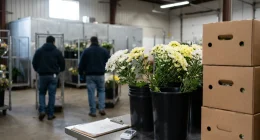

A floral cold chain checklist is the cheapest shrink-reduction tool a grocery floral buyer has, because most quality loss happens in handoffs rather than at the farm. Cut flowers respond to temperature almost immediately, and a few degrees of drift at a dock can undo a perfect pre-cool. This checklist walks the route from the farm truck to the store cooler and flags the questions to put to every shipper, carrier and distribution center.
What temperature should cut flowers be held at?
Most non-tropical cut flowers are stored at 33°F to 35°F (0°C to 2°C), according to cold-chain monitoring company Sensitech and flower-care company Chrysal. Sensitech says most start to wilt at 37°F and that flowers can show stress from swings as small as 2°F. Tropical flowers, including tropical orchids, are generally held warmer, around 50°F to 55°F, and chilling-sensitive species need slightly higher temperatures than the standard range. Confirm the range for each product on your order guide rather than setting one number for the whole truck.
The 12-point floral cold chain checklist
At the farm or consolidator
- Pre-cooling is documented. Chrysal recommends removing field heat as fast as possible with forced-air or vacuum cooling before storage and transport. Ask for pre-cool times or records.
- Hydration and treatment are done. Post-harvest hydration solutions support water uptake, and anti-ethylene treatments (Chrysal names AVB and Ethylene Buster) protect ethylene-sensitive flowers. Ask which products carry which treatment.
- Boxes are staged in cold storage until loading. Flowers sitting on an ambient dock lose the benefit of the pre-cool.
On the truck or plane
- The trailer is pre-cooled before loading. A warm trailer pulls heat back into the product.
- A data logger rides with the load. Continuous monitoring with alarms catches deviations before quality is affected, Sensitech says. Make sure you receive the readings, not just the logger.
- Loads are mixed on purpose. Tropicals and standard cut flowers need different temperatures, so do not combine them without a plan.
At the cross-dock or distribution center
- Dwell time is short and in the cold. Sensitech cites a supplier case where re-palletizing took five hours at a dock held at 55°F and flower temperature rose by more than 10 degrees. Ask how long product sits and at what temperature.
- Dock doors and staging areas are refrigerated. Map every handoff, from harvest and cooling through ground or air transit, cross-docks, distribution centers and retail.
- Cooler temperatures are measured, not assumed. Chrysal’s rule is to measure, not assume. Log probe readings at set times.
At the store
- Receiving checks product temperature on arrival. Reject or flag loads that arrive warm, and photograph the logger reading.
- Back-room coolers match the product range. Standard flowers and tropicals may need separate space.
- Buckets, coolers and trucks are clean. Chrysal lists clean buckets, storage rooms and transport equipment as part of the system.
How often do shipments miss the target?
The only quantified example we found is old and vendor supplied, so treat it as a signal, not a benchmark. Sensitech reports that a U.S. customer monitored 700 cut-flower shipments in 2015 with its loggers and 59% triggered high-temperature alarms. A European supplier in the same article found flowers exposed to chilling temperatures between the packing facility and the store. The lesson is the same in both directions: too warm and too cold both cost you vase life.
What should you ask carriers and suppliers?
Ask for logger data on every peak-season load, a written holding temperature by product type, the maximum time product may sit at a dock, and who is responsible for claims when readings are out of range. Peak weeks raise the cost of a loss, which is why Sensitech flags Valentine’s Day and Mother’s Day as the highest-risk shipments. Our guide to flower care and handling at scale covers coolers, hydration and ethylene in the store, and our shrink guide shows how lost days of vase life turn into markdowns. For context on rising transport costs, see our report on freight pressure on the global flower supply chain.
Takeaways: floral cold chain checklist for buyers
- Hold most cut flowers at 33°F to 35°F and tropicals warmer, and verify with probes.
- Demand logger data and short, cold dock dwell times, the weakest link in the cases above.
- Walk every handoff from farm to store cooler and assign an owner for each.
- Tighten the checklist before Valentine’s Day and Mother’s Day, when losses cost the most.

Travis Rigby is the publisher of SuperFloral, the news source for the mass-market floral industry. He leads its website and weekly newsletter, covering what matters to growers, breeders, supermarket floral buyers and category managers. Travis studied journalism at the University of Utah, founded and led PosterGarden.com for 27 years, and is president of FlowerBox.com.